Gettysburg
We live less than an hour from Gettysburg, and I’m a little ashamed to say how little I knew about the place before spending a few days there this November. I had been before, the way most people around Harrisburg have been. You take Route 15 south, you follow the signs, you see a monument or two, and you drive home. This time we came in on the rural back roads instead of the main drag. That one change made it a different trip.
The Long Way In
On this incredible fall morning we decided to take back roads on our way to the Gettysburg area. We found ourselves outside Biglerville and the first thing I noticed was the orchards. Rows of fruit trees ran over rolling hills, farmhouses sat well back from the road, and for long stretches we saw no one at all. The country around there is stunning and sparse. In this part of the state, where open land keeps filling in with new developments and warehouses, that is a refreshing sight. It turns out I was driving through some of the best fruit country in the United States. The area is called the Historic South Mountain Fruit Belt, and Adams County is Pennsylvania’s largest producer of apples and peaches. Before heading to Gettysburg, my wife wanted to check out Mister Ed’s Elephant Museum & Candy Emporium, a kitschy roadside attraction with tons of candy inside, a fantastic and whimsical garden outside and elephants absolutely everywhere. No corporate glitz, just genuine family fun on a remote stretch of Route 30 (the “Lincoln Highway”).
Speaking of the Lincoln Highway, it was kind of ironic that on this day (November 19th) “Lincoln” caused a major detour on the road that bears his name as it was the anniversary of his Gettysburg Address and the entire center of Gettysburg was closed to traffic due to this annual festival. As for the town itself, it is small with barely over 7,000 residents according to the 2020 census. Its center is Lincoln Square and the David Wills House, where Lincoln spent the night before his famous address, still stands there. Just a few hundred feet from the square on York Street is the Upper Crust, situated inside a big restored building with three wood-fired pizza ovens in an open kitchen. We had lunch there and it had a cool vibe with good food, reasonably priced, along with the added bonus of pool tables, air hockey, shuffleboard, Skee-Ball and more arcade games for free.
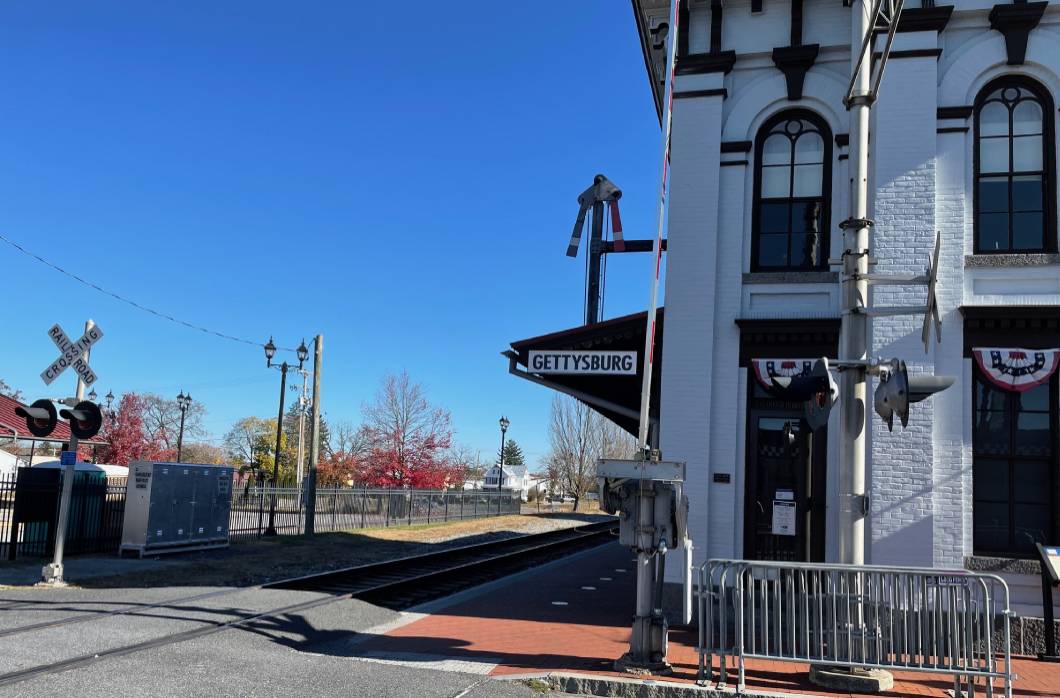
But of course the main attraction is not the town itself but the historical battlefields which surround it. The hub of this attraction is the Museum and Visitor Center and it is huge, and there is more going on inside than I expected. The building is free to enter but tickets are required for its three major things: a film, the cyclorama and the museum itself, the Gettysburg Museum of the American Civil War. Here tickets cost more than most museums we visit, and security is a bit tighter. I put both down to how popular the place is (the Park Service says the battlefield draws nearly one million visitors a year). We walked into the visitor center around 10:30 in the morning and had it nearly to ourselves. Fifteen minutes later, a group of about 50 college students came through the doors and then the floodgates were open. My advice is to go early.
So what is a Cyclorama?
I’ll admit I didn’t know what a cyclorama was until I was standing in the middle of one. It is an enormous painting hung in a full circle around a viewing platform. In front of the canvas, a real three-dimensional foreground of fences, stone walls and broken trees blends into the painted scene, so the battle seems to surround you. The Park Service says cycloramas were a popular entertainment in America and Europe in the late 1800s. Hundreds were painted. Most were lost or destroyed once motion pictures came along.
The Gettysburg painting survived. The French artist Paul Philippoteaux painted it to show Pickett’s Charge on July 3, 1863. He came to Gettysburg in 1882, spent several weeks on the battlefield making hundreds of sketches, hired a local photographer to take panoramic photographs, and interviewed veterans. His first version opened in Chicago in 1883. The one in the visitor center is his second version, which opened in Boston in 1884 and came to Gettysburg in time for the battle’s 1913 anniversary. It is 377 feet long and 42 feet high, and it weighs 12.5 tons. A $13 million restoration began in 2003, and the painting was unveiled in its current gallery on September 26, 2008.
Three Days in July
The battle ran from July 1 to July 3, 1863. Gen. Robert E. Lee led the Confederate Army of Northern Virginia. Maj. Gen. George G. Meade led the Union Army of the Potomac, a job he had been given only on June 28. More than 165,000 soldiers fought here. The Park Service counts more than 51,000 casualties, meaning soldiers killed, wounded, captured or missing. Overall, it was the largest battle ever fought in North America.
Lee saw the importance in Gettysburg which, despite being a very small town, was a crossroads leading to seven neighboring communities many of which had occupying Confederate troops in the Summer of 1863. On the morning of July 1st, the fighting opened on McPherson Ridge, west of town, as Union cavalry met Confederate infantry coming east on the Chambersburg Pike. The Union line held until afternoon, then fell back through the streets to Cemetery Hill. On July 2nd the armies faced each other along parallel ridges about a mile apart, the Union on Cemetery Ridge and the Confederates on Seminary Ridge. Lt. Gen. James Longstreet’s attack on the Union left reached the base of Little Round Top and swept through the Wheatfield and the Peach Orchard. Lt. Gen. Richard Ewell’s evening attack struck Culp’s Hill and East Cemetery Hill on the other end. The Union line bent and held.
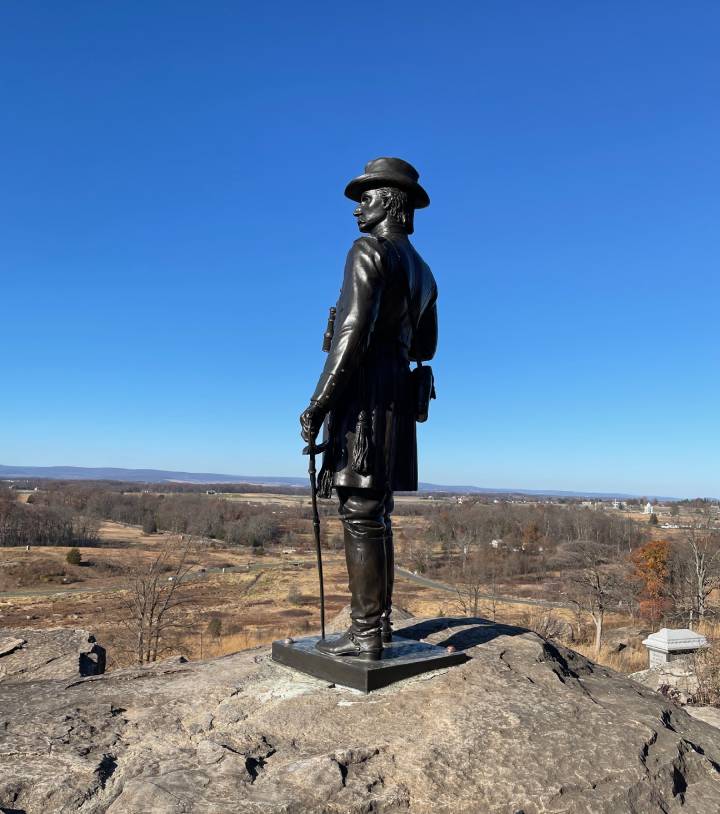 Then it all climaxed on July 3rd. After a two-hour artillery bombardment, about 12,000 Confederates crossed a mile of open fields toward the Union center on Cemetery Ridge. That attack is known as “Pickett’s Charge”. It failed, and the Park Service says it cost Lee more than 5,000 soldiers in about an hour. Finally on July 4th (as the country celebrated its four score and seven year birthday), Lee began his retreat to Virginia. The Battle of Gettysburg was the turning point in the eastern theater of the war. After it, the Confederate army could no longer sustain an offensive.
Four and a half months later, Lincoln arrived to dedicate the Soldiers’ National Cemetery and (following a two-hour speech by Edward Everett) delivered his famous address in about two minutes. He described a nation “conceived in liberty and dedicated to the proposition that all men are created equal” and asked whether it could endure. Our visit fell in the same month as that anniversary. This year, for the nation’s 250th birthday (and during our visit), the Park Service and its partners recreated Lincoln’s whole visit, from his arrival by train on November 18, 1863 to the procession from the Wills House to the cemetery on the 19th.
Sixteen Stops and 1,300 Monuments
The best part of the trip was the self-guided auto tour. You follow a well-marked route around the battlefield through the places where the fighting happened. There are 16 numbered stops along 24 miles. The route starts at the visitor center, runs through the battle in the order it happened, and ends at the National Cemetery. It is free, and the battlefield roads are open every day from 30 minutes before sunrise to 30 minutes after sunset. The Park Service says to allow at least three hours, and I would allow more.
The official National Park Service app makes it better. You download it, pick Gettysburg National Military Park, and open the Auto Tour of Gettysburg, and at every stop you get the story of what happened while you look at the ground where it happened.
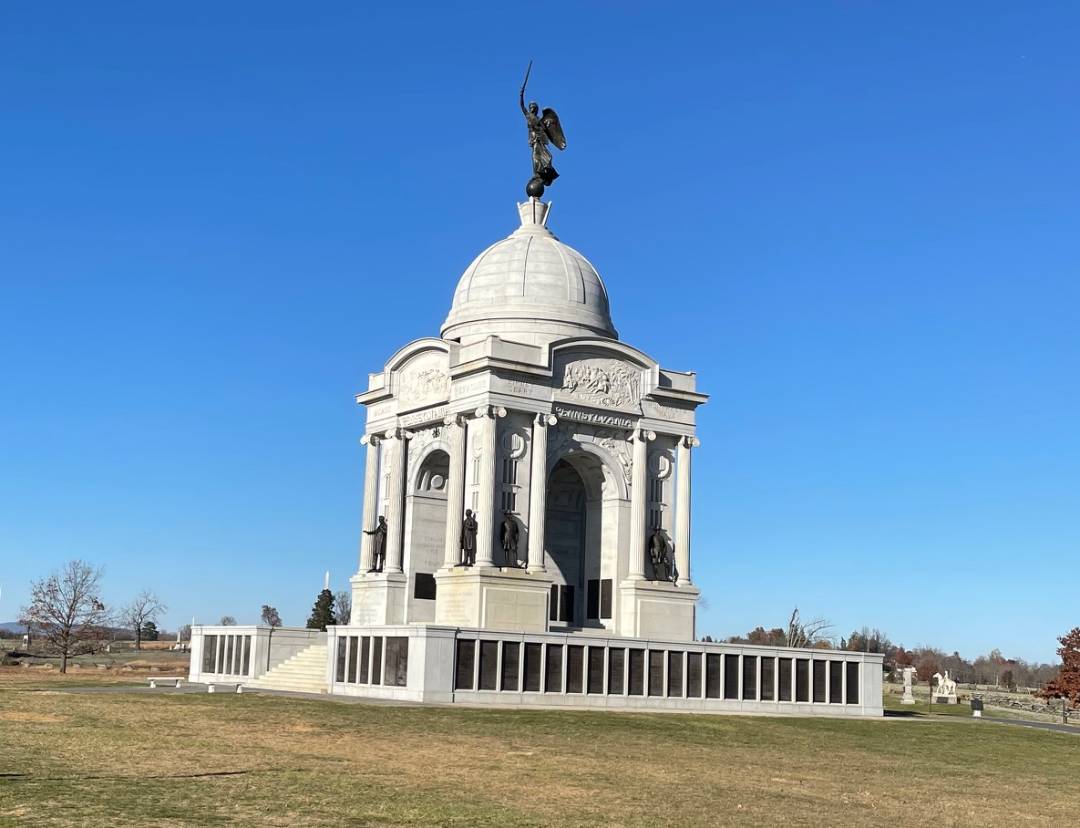
Then there is everything between the stops. The park has more than 1,300 monuments, markers and tablets, 400 cannons, 31 miles of historic avenues and 147 historic buildings on more than 6,000 acres. It is impossible to see everything in one visit, but a true marvel of preservation and dedication as many of the monuments were placed by veterans of the war itself between 1880 and 1927, as they marked where their regiments stood.
Just an Hour from Home
I went to Gettysburg thinking I knew it. I came home knowing the name of the man who painted the cyclorama, the ridge where the fighting opened and the county’s place in the country’s apple crop. All of it had been less than an hour from my house the whole time. Next time I’ll take the back roads again.
~